
 Cart



Key Takeaways
- Haze does not automatically cause acne, but air pollution may contribute to inflammation and aggravate acne-prone skin in some people.
- Singapore’s heat, humidity, sweat, sebum, sunscreen and makeup can add to the feeling of congestion during prolonged hazy periods.
- You may notice more blackheads, whiteheads, small bumps, oiliness or clogged pores, particularly if your skin is already prone to congestion.
- Avoid responding by washing, scrubbing or exfoliating your face more aggressively. This can leave the skin barrier more irritated.
- Continue wearing sunscreen during the haze and remove sunscreen and makeup thoroughly at the end of the day.
- The most important distinction is between congestion and irritation. Blackheads and suitable whiteheads may benefit from extraction, while red, painful or highly sensitive skin may need to be calmed first.
- A professional facial cannot “detox” haze from your body, but an extraction-focused treatment can help clear genuine pore congestion that has built up.
- If stubborn blackheads, whiteheads and clogged pores are your main concern, My Cozy Room’s Ultimate Pore Extraction Facial may be suitable after a skin assessment.
If your skin has been feeling unusually oily, irritated or congested lately, there is one environmental change that has been difficult to ignore: Singapore is going through one of its most significant haze episodes in years.
Air quality first entered the Unhealthy range in early September 2026, but conditions became noticeably worse in October. The Straits Times reported that the current episode has been Singapore’s longest stretch of poor air quality since 2015, with unhealthy PSI readings persisting from 5 October. The ongoing haze has been linked to fires in Indonesia, with winds carrying smoke from Kalimantan and Sumatra towards Singapore.
Conditions became particularly severe in the middle of the month. On 14 October, the one-hour PM2.5 reading in western Singapore reached 288, placing it in the Very High band and marking the highest hourly reading Singapore had seen since 2015. Outdoor sports facilities were closed and activities were suspended in response to the deteriorating air quality.
The haze continued over the following days. On 16 October, the 24-hour PSI reached 229 in central Singapore, while the east and west also entered the Very Unhealthy range.
And the situation has remained changeable. On Sunday, 18 October, western Singapore’s 24-hour PSI reached 230 at 10am — the highest reading recorded anywhere in Singapore so far this year. Conditions improved somewhat later in the day, although all five regions were still in the Unhealthy range at 9pm. NEA has forecast the PSI to remain between 101 and 190 on Monday, 19 October, while warning that changing wind directions could continue bringing smoke haze towards Singapore.
Most of the conversation around haze understandably focuses on breathing, outdoor activity and respiratory health. But our skin is also directly exposed to the surrounding environment throughout the day.
That raises another question, particularly for anyone who has suddenly noticed more bumps, oiliness or clogged pores: can the haze cause acne?
About This Guide
This guide looks at how Singapore’s haze may affect the skin, with a particular focus on acne, clogged pores, blackheads and skin irritation.
Rather than treating haze as a direct cause of every breakout, we look at the more realistic combination of factors that can affect your complexion during periods of poor air quality, including pollution exposure, heat, humidity, sweat, sebum, sunscreen and makeup.
We also cover how to adjust your skincare routine without over-cleansing or over-exfoliating, when congested skin may benefit from professional extraction, and when redness or inflammation is a sign that your skin needs a gentler approach instead.
Can the Haze Cause Acne?
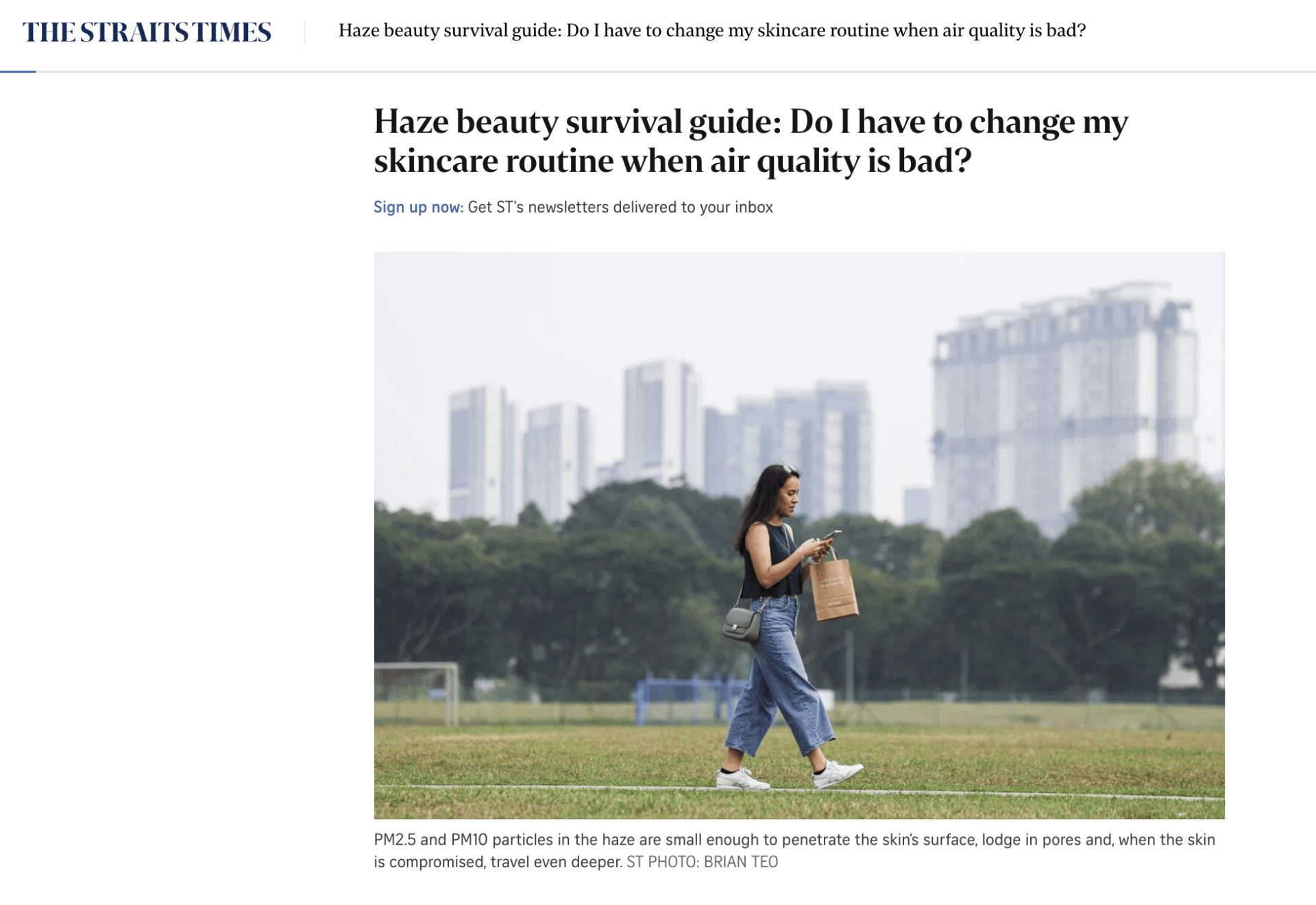
Not quite in the straightforward sense that spending a few hours outside will automatically give you pimples. Acne has many contributing factors, including oil production, blocked follicles, inflammation, hormones and genetics. But there is growing attention on how air pollution may aggravate skin that is already acne-prone.
It is a question that has been coming up in Singapore as the haze returns. In September 2026, Her World spoke to aesthetic physician Dr Rachel Ho about why skin may look worse on hazy days. She explained that pollutants found in haze can disrupt the skin barrier, generate oxidative stress and activate inflammatory pathways, and noted that inflammatory skin conditions including acne can be exacerbated by air pollution.
The Straits Times looked specifically at this question in its September haze skincare guide. Dermatologist Dr Coni Liu told the paper that breakouts and clogged pores may become more noticeable during the haze, while also cautioning that the relationship between pollution and acne is not as clear-cut as it is for some other inflammatory skin conditions. The report noted that particulate pollution has been associated with increased sebum production and inflammatory markers, both of which could contribute to an acne flare.
That fits with what Singapore doctors have been observing more broadly about adult acne. In a CNA Lifestyle report earlier this year, Dr Yong described Singapore’s hot, humid climate as one reason sweat and oil production can contribute to clogged pores, adding that periodic haze and air pollution expose the skin to fine particles and oxidative stress that may worsen breakouts.
There is an added complication in Singapore: haze does not arrive in a vacuum. Your skin is simultaneously dealing with heat, humidity, sweat, sebum, sunscreen and makeup. If you already develop blackheads, whiteheads or clogged pores easily, all of these factors can overlap, leaving your complexion feeling oilier, bumpier or noticeably more congested during a prolonged hazy spell.
This is why it is more accurate to say that haze may aggravate acne or contribute to conditions that make breakouts more noticeable, rather than saying that haze simply “causes acne”.
It also explains why two people can spend the same amount of time outdoors and have completely different experiences. Someone with relatively balanced skin may notice little more than dryness or irritation, while someone who already struggles with oily skin and clogged pores may start seeing more blackheads, closed comedones or small breakouts.
So if you have been searching for “can haze cause acne?”, “why am I breaking out during the haze?” or “can haze clog pores?”, you are certainly not the only one wondering about the connection.
The more useful question is what has actually changed in your skin. If it is mainly red, dry and irritated, your skin barrier may need a gentler approach. But if you are seeing a genuine build-up of blackheads, whiteheads and stubborn clogged pores, that congestion may need to be addressed differently — which is where professional pore extraction can be useful.
Can Haze Cause Pimples?
Haze itself does not automatically cause pimples, but pollution exposure may be one of several environmental factors that aggravate acne-prone skin.
Air pollution contains very small particles and other pollutants that come into contact with exposed skin throughout the day. Pollution exposure has been associated with oxidative stress and inflammation, while also affecting the skin’s normal barrier function.
At the same time, Singapore’s humid weather encourages sweating and oil production. Add sunscreen, makeup and a day spent outdoors, and your skin may simply feel much more congested than usual.
You may notice:
- more oiliness by the end of the day
- tiny bumps or closed comedones
- whiteheads appearing more frequently
- blackheads looking more obvious
- existing pimples becoming redder or more irritated
- rough or uneven skin texture
- pores that seem more congested than they normally are
This does not necessarily mean pollution particles have somehow become permanently trapped inside your pores. It is more useful to look at the overall environment your skin is experiencing.
Why Does My Skin Break Out More During Haze Season?
There is rarely one single reason. For acne-prone skin, haze season may coincide with several things that make congestion more likely.
More Sweat and Sebum
Singapore is already hot and humid. When you spend time outdoors, perspiration mixes with your skin’s natural oils as well as whatever skincare and sunscreen you are wearing. That does not automatically create acne, but if your pores clog easily, you may begin noticing more congestion.
Sunscreen and Makeup Build-Up
You should absolutely continue wearing sunscreen during hazy weather, as the haze does not block UV radiation. However, water-resistant sunscreen, foundation and other products need to be removed properly at the end of the day.
If your usual evening cleanse is not thoroughly removing what you have been wearing, residue combined with oil and sweat may make your complexion feel increasingly congested.
Pollution May Make Skin More Reactive
Air pollution has been associated with oxidative stress, inflammatory responses and changes in skin-barrier function.
Some people therefore notice that their skin becomes more sensitive or less comfortable during prolonged periods of poor air quality.
That creates an awkward situation for anyone who is both acne-prone and sensitive: you may have more clogged pores while your skin is simultaneously less tolerant of aggressive acne treatments.
You May Start Over-Cleansing
This is one of the easiest haze skincare mistakes to make.
When your face feels grimy after being outdoors, washing it repeatedly or reaching for stronger scrubs can feel logical. Unfortunately, leaving the skin tight, dry or irritated does not necessarily make acne better.
If anything, an already reactive complexion may become even more uncomfortable.
What Skin Problems May Feel Worse During the Haze?
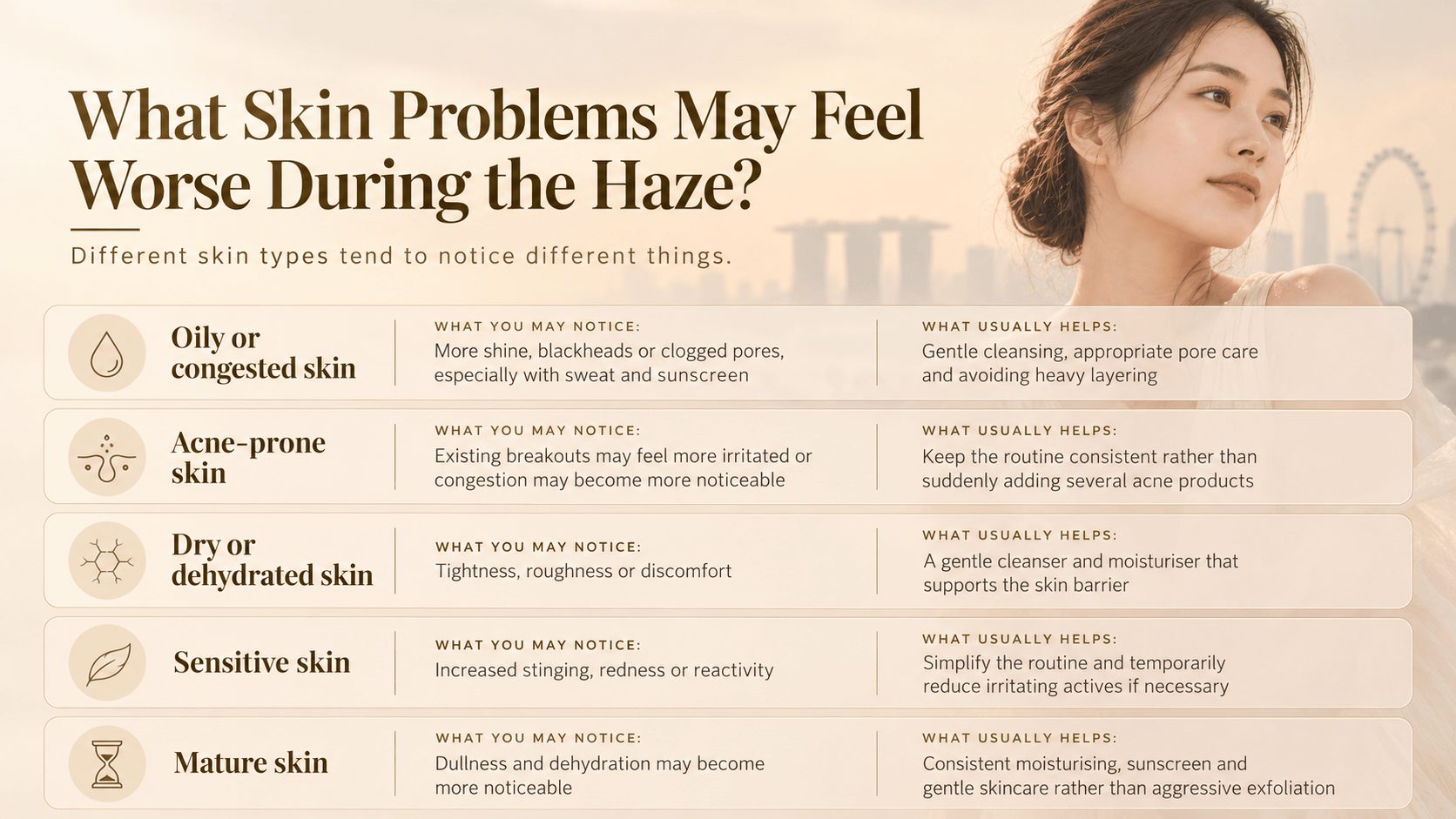
Not everyone will react to hazy weather in the same way. Some people barely notice a difference, while others find that their usual skin concerns become more obvious after several days of poor air quality.
If you already have oily, acne-prone or easily congested skin, you may be particularly conscious of changes because Singapore’s heat and humidity add another layer to the problem. Sweat, sebum, sunscreen and makeup can accumulate over the course of the day, and you may start noticing more blackheads, whiteheads or small bumps than usual. Other skin types can be affected too:
| Skin concern | What you may notice during haze season | What may help |
|---|---|---|
| Oily or congested skin | More shine, rough texture, blackheads or pores that seem more clogged, particularly after sweating or wearing sunscreen all day | Cleanse thoroughly but gently, avoid excessive product layering and consider professional pore extraction if stubborn congestion builds up |
| Acne-prone skin | More small bumps, whiteheads or existing breakouts appearing angrier or more noticeable | Keep your routine consistent, avoid picking or squeezing and do not suddenly introduce several strong acne products at once |
| Blackhead-prone skin | Blackheads around the nose, chin or cheeks may become more noticeable as the complexion becomes oilier or more congested | Avoid DIY squeezing; stubborn, extractable congestion may benefit from professional extraction |
| Dry or dehydrated skin | Tightness, roughness, flaking or a complexion that feels less comfortable than usual | Use a gentle cleanser and moisturiser and avoid repeatedly washing your face simply because the air feels dirty |
| Sensitive skin | Increased redness, stinging, itching or general reactivity | Simplify your routine and temporarily cut back on potentially irritating actives if your skin is struggling |
| Mature skin | Dehydration, roughness and dullness may become more noticeable | Focus on consistent moisturising, sunscreen and gentle skincare rather than aggressive exfoliation |
One important distinction is whether your skin is becoming congested or irritated. If you can see new blackheads, whiteheads and clogged pores but your skin otherwise feels comfortable, pore congestion may be the bigger issue. This is the situation in which an extraction-focused treatment such as our Ultimate Pore Extraction Facial may be useful.
If your face is instead burning, very red, flaky or unusually sensitive, trying to extract or exfoliate everything away is unlikely to be the best first move. Your skin may need a gentler approach while its barrier settles.
And if you develop persistent swelling, a significant rash, severe itching or a substantial flare of an existing skin condition, it is better to speak to a doctor or dermatologist rather than treating it as a simple haze-related breakout.
Can Haze Cause Clogged Pores and Blackheads?
Not directly. Haze particles do not simply settle into your pores and turn into blackheads. Blackheads form when a pore becomes clogged with a mixture of sebum and dead skin cells. Once that material is exposed to air, it oxidises and darkens, creating the familiar black appearance.
What haze season can do, however, is make an already congestion-prone complexion feel noticeably worse. In Singapore, poor air quality often comes together with heat and humidity, which means your skin may also be dealing with more sweat, oil, sunscreen and makeup throughout the day.
If you are naturally oily or prone to clogged pores, that combination can leave your skin feeling rougher, heavier or bumpier than usual. You may notice that blackheads around the nose and chin become more obvious, or that small whiteheads and closed comedones start appearing more frequently.
The important thing is not to assume that every bump should be squeezed. Red, painful or cystic acne is not something you should try to extract at home. Blackheads and suitable whiteheads, on the other hand, may respond well to professional extraction when the skin is properly prepared and the congestion is removed carefully.
This is one reason an extraction-focused facial can be useful when haze season leaves your skin feeling particularly clogged: the aim is not to “remove pollution” from your pores, but to address the blackheads, whiteheads and congestion that are actually present.
Should You Extract Blackheads During Haze Season?
If the haze seems to have coincided with more visible blackheads or whiteheads, the first instinct is often to squeeze them. That is usually where things start to go wrong.
Pressing repeatedly at the skin, especially around the nose and chin, can leave the area inflamed, sore or marked afterwards. It is also easy to misjudge what is actually ready to be extracted and keep applying pressure to a bump that should have been left alone.
Professional extraction is more controlled. The skin is first assessed and prepared, and only suitable congestion is worked on. This matters even more if your complexion has been feeling reactive during the haze, because aggressive squeezing can add another layer of irritation.
If your skin feels mainly clogged, bumpy or congested rather than red and inflamed, an extraction-focused facial may be a more appropriate way to deal with stubborn blackheads and whiteheads. The goal is simply to clear what is genuinely extractable without unnecessarily traumatising the surrounding skin.
When a Pore Extraction Facial May Help
You do not need to book a facial simply because the PSI has gone up. The better reason to consider one is when you can see that your skin has genuinely become more congested.
Perhaps the blackheads around your nose look more obvious than usual, your chin feels covered in tiny bumps, or whiteheads seem to keep returning despite your normal cleansing routine. If the skin itself is otherwise relatively calm, this is the kind of congestion that may benefit from professional extraction.
At My Cozy Room, our Ultimate Pore Extraction Facial is designed specifically for blackheads, whiteheads and stubborn clogged pores. The 120-minute treatment begins with proper skin preparation before meticulous manual extraction, followed by soothing and hydrating steps to help keep the complexion comfortable afterwards.
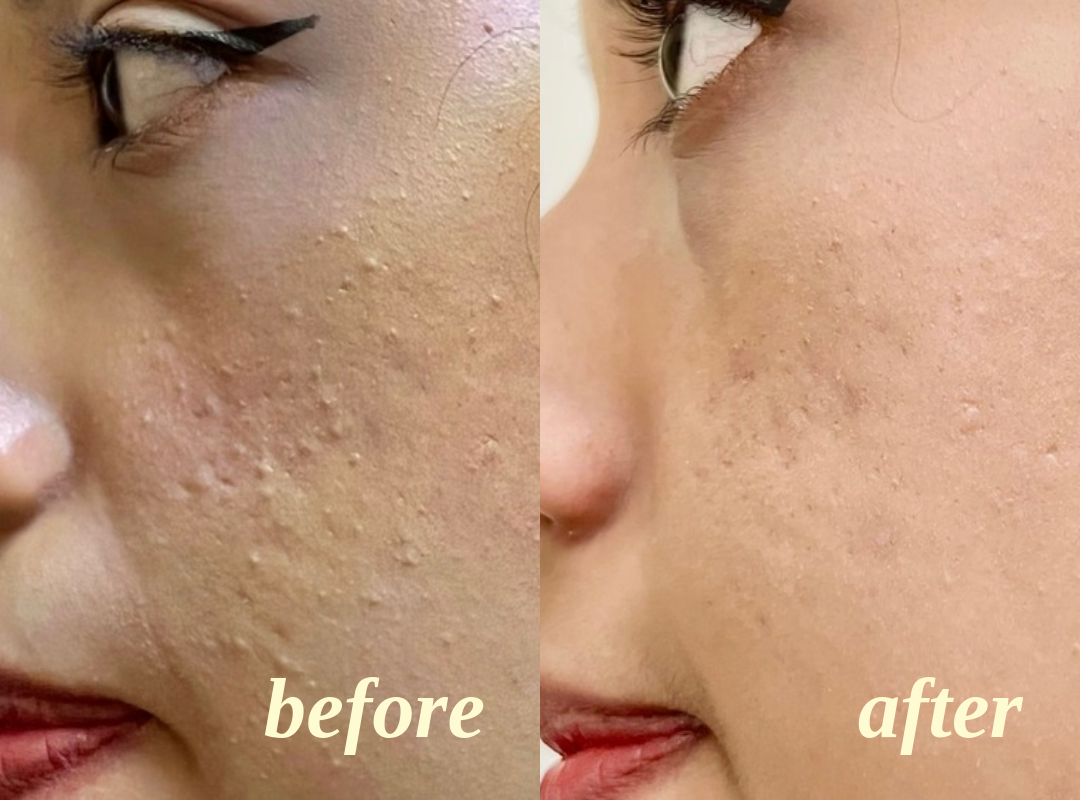
The aim is not to “detox” haze or claim to pull pollution out of your skin. It is much more straightforward: to assess what is actually clogging your pores and carefully clear the congestion that can be safely extracted.
This distinction matters during haze season because not every breakout needs the same approach. If your skin is red, sore or heavily inflamed, extraction may not be suitable for every area. But if what you are mainly seeing is persistent blackheads, whiteheads and bumpy congestion, an extraction-focused facial can help deal with what your regular at-home routine has not been able to clear.
Every treatment at My Cozy Room starts with a skin consultation, so the facial can be adjusted according to how your complexion is behaving on the day rather than treating every haze-related skin concern in exactly the same way.
Can a Facial Remove Haze or Pollution From Your Skin?
A facial can help remove surface build-up, cleanse the skin thoroughly and clear suitable blackheads and whiteheads, but it is important not to confuse this with “detoxing” pollution from the skin or body.
During haze season, the more useful question is whether your skin has actually become congested. If you are noticing stubborn blackheads, whiteheads or clogged pores that are not shifting with your usual routine, an extraction-focused facial may help clear that build-up.
If your pores are relatively clear and your main complaint is dryness, tightness or sensitivity, extraction may not be what your skin needs at that point.
This is why every facial at My Cozy Room begins with a skin consultation. Rather than assuming haze automatically calls for a particular treatment, we look at whether the skin is congested, irritated, dehydrated or a combination of several concerns before deciding how to proceed.
What If My Haze Breakout Is Red and Inflamed?

More pimples during a hazy spell do not automatically mean you need more extraction. If your skin is unusually red, sore, flaky, hot or stingy, the priority may be to calm it down first. The same applies to deep, painful or cystic acne, which should not simply be squeezed in an attempt to make it disappear faster.
This is especially relevant during haze season because skin can sometimes be both acne-prone and irritated at the same time. You might have some clogged pores that are suitable for extraction alongside other areas that are better left alone.
A proper consultation allows the therapist to make that distinction. At My Cozy Room, the treatment can be adjusted according to how your skin looks and feels on the day, rather than treating every bump in exactly the same way.
How Should I Clean My Face After Being Outside in the Haze?
Fortunately, you do not need to rush to the sink every time you step outdoors.
If you have been outside for an extended period, exercising or sweating heavily, cleansing when you get home can make sense. For an ordinary day, however, your usual evening cleanse is generally sufficient.
What matters the most is removing the day’s build-up properly without leaving your skin feeling stripped afterwards. If you wear makeup or water-resistant sunscreen, double cleansing can be useful. Start with a cleansing oil, balm or another product designed to break down makeup and sunscreen, then follow with your regular cleanser.
If a single gentle cleanse already removes everything comfortably, there is no need to add an extra step purely because the air is hazy.
Most importantly, resist the temptation to scrub harder because your face feels “dirty”. The aim is to remove sweat, oil, sunscreen and surface build-up without creating a new problem by irritating the skin barrier.
Should I Exfoliate More Because of the Haze?
Probably not. When your skin starts feeling rough or your pores look more noticeable, it is tempting to reach for another scrub, acid or exfoliating toner. But stronger or more frequent exfoliation is not necessarily going to clear congestion faster, particularly if your complexion is already feeling sensitive.
If salicylic acid, retinoids or other exfoliating products are already part of your routine and your skin continues to tolerate them well, you do not need to stop them simply because of the haze.
On the other hand, if your skin has become unusually stingy, flaky, red or tight, this is probably not the best time to start layering on additional actives. Simplifying your routine for a while can give the skin a chance to settle.
And if the issue is stubborn blackheads or whiteheads rather than surface roughness, repeatedly exfoliating at home may not solve the problem. That is where professional assessment and, where appropriate, extraction can be more useful than simply adding another acid.
Do You Still Need Sunscreen During the Haze?
Yes. A grey or smoky-looking sky does not mean UV exposure has disappeared.
Continue wearing broad-spectrum sunscreen when you are outdoors, especially if you are prone to post-acne marks or pigmentation, as sun exposure can make discolouration more noticeable.
If you have oily or acne-prone skin, choose a sunscreen texture that feels comfortable on your complexion rather than skipping sunscreen out of fear that it will clog your pores.
The other half of the equation is removal. If you are wearing a heavier or water-resistant sunscreen throughout the day, make sure it is thoroughly cleansed off in the evening.
A Simple Haze Skincare Routine for Acne-Prone Skin
If you tend to break out easily, haze season is usually not the time to completely reinvent your skincare routine.
In the morning, keep things simple with the products your skin already tolerates, followed by sunscreen. During the day, try not to touch or rub your face unnecessarily, especially after being outdoors. If you become very sweaty, blot or wipe the skin gently rather than repeatedly scrubbing at it. When you get home, cleanse thoroughly enough to remove sweat, sunscreen, makeup and the day’s build-up. At night, moisturise and continue with acne treatments that your skin normally handles well.
The most useful thing you can do is pay attention to what kind of problem you are actually dealing with.
If your complexion is mainly red, tight or uncomfortable, it probably needs a gentler approach. If it feels relatively calm but you can see a growing collection of blackheads, whiteheads and persistent bumps, the issue is more likely to be congestion. When those clogged pores are no longer improving with your normal routine, that is when an extraction-focused treatment such as the Ultimate Pore Extraction Facial may be worth considering.
Rather than trying to scrub or squeeze everything away at home, the skin can first be assessed to determine which areas are genuinely suitable for extraction and which should be left alone.
When Should You Consider an Ultimate Pore Extraction Facial?
An extraction facial may be worth considering if the haze has coincided with a noticeable increase in:
- stubborn blackheads around the nose, chin or cheeks
- recurring whiteheads
- small, persistent bumps
- pores that feel more congested than usual
- rough texture that is not improving with your normal cleansing routine
The key is that your skin should be congested rather than severely irritated. If it is very red, sore, flaky or inflamed, a gentler approach may be more appropriate first.
If you are unsure, your therapist can assess your skin before treatment and determine whether the Ultimate Pore Extraction Facial is suitable for the congestion you are experiencing.
Frequently Asked Questions About Haze and Acne
Can haze cause acne?
Haze does not directly cause every acne breakout. Acne is influenced by oil production, blocked follicles, inflammation, hormones, genetics and other factors. Pollution exposure may nevertheless contribute to inflammation or aggravate acne-prone skin in some people.
Why am I getting pimples during the haze?
Your skin may be dealing with several factors at once, including pollution exposure, Singapore’s heat and humidity, sweat, sebum, sunscreen and makeup. If you are already prone to clogged pores, you may notice more congestion during this period.
Can haze clog your pores?
It is more accurate to say that haze season can coincide with conditions that make congestion more noticeable rather than claiming that individual haze particles simply lodge permanently inside your pores. Sweat, sebum, sunscreen, makeup and environmental build-up can all contribute to how congested your complexion feels.
Can haze cause blackheads?
Blackheads develop when pores become clogged with sebum and dead skin cells and the material at the surface oxidises. Haze is not the direct cause of a blackhead, but some acne-prone people may notice more congestion during periods of poor air quality.
Should I wash my face more often when it is hazy?
Not necessarily. Clean your face thoroughly enough to remove sweat, sunscreen, makeup and daily build-up, but repeatedly washing or scrubbing your skin may leave it irritated.
Should I exfoliate more during haze season?
Usually not. If your skin already feels sensitive, increasing exfoliation can make irritation worse. Continue products that your skin normally tolerates rather than suddenly adding several stronger ones.
Does a facial remove pollution from your pores?
A facial can cleanse the skin and professionally remove suitable blackheads and whiteheads. It should not be marketed as removing “toxins” or detoxifying pollution from your body.
Is an extraction facial good for haze-related breakouts?
It may be useful if the main problem is genuine pore congestion such as blackheads and whiteheads. If your skin is very inflamed, irritated or experiencing a more serious acne flare, extraction may not be appropriate for every area.
Is Your Skin Feeling More Congested During the Haze?
Haze does not mean you need to overhaul your entire skincare routine. but it is worth paying attention to what your skin is actually doing.
If it feels dry, irritated or unusually sensitive, be gentle with it. If you are instead noticing an obvious build-up of stubborn blackheads, whiteheads and clogged pores, simply cleansing more aggressively at home may not solve the problem.
My Cozy Room’s Ultimate Pore Extraction Facial is designed specifically to tackle this kind of congestion. Each session begins with an assessment of your skin before suitable clogged pores are carefully extracted, with soothing and hydrating care afterwards.
There are no claims about “pulling haze toxins” from your skin. The aim is much simpler: clear the congestion that is actually there without unnecessarily aggravating your complexion.
If Singapore’s haze has coincided with your pores looking much more clogged than usual, book an Ultimate Pore Extraction Facial at My Cozy Room at Claymore Connect or Devonshire, or WhatsApp us to find out whether extraction is suitable for your skin.

More from The Cozy Journal